
Achalasia Cardia: Symptoms, Causes and How Heller Myotomy Helps in Treatment
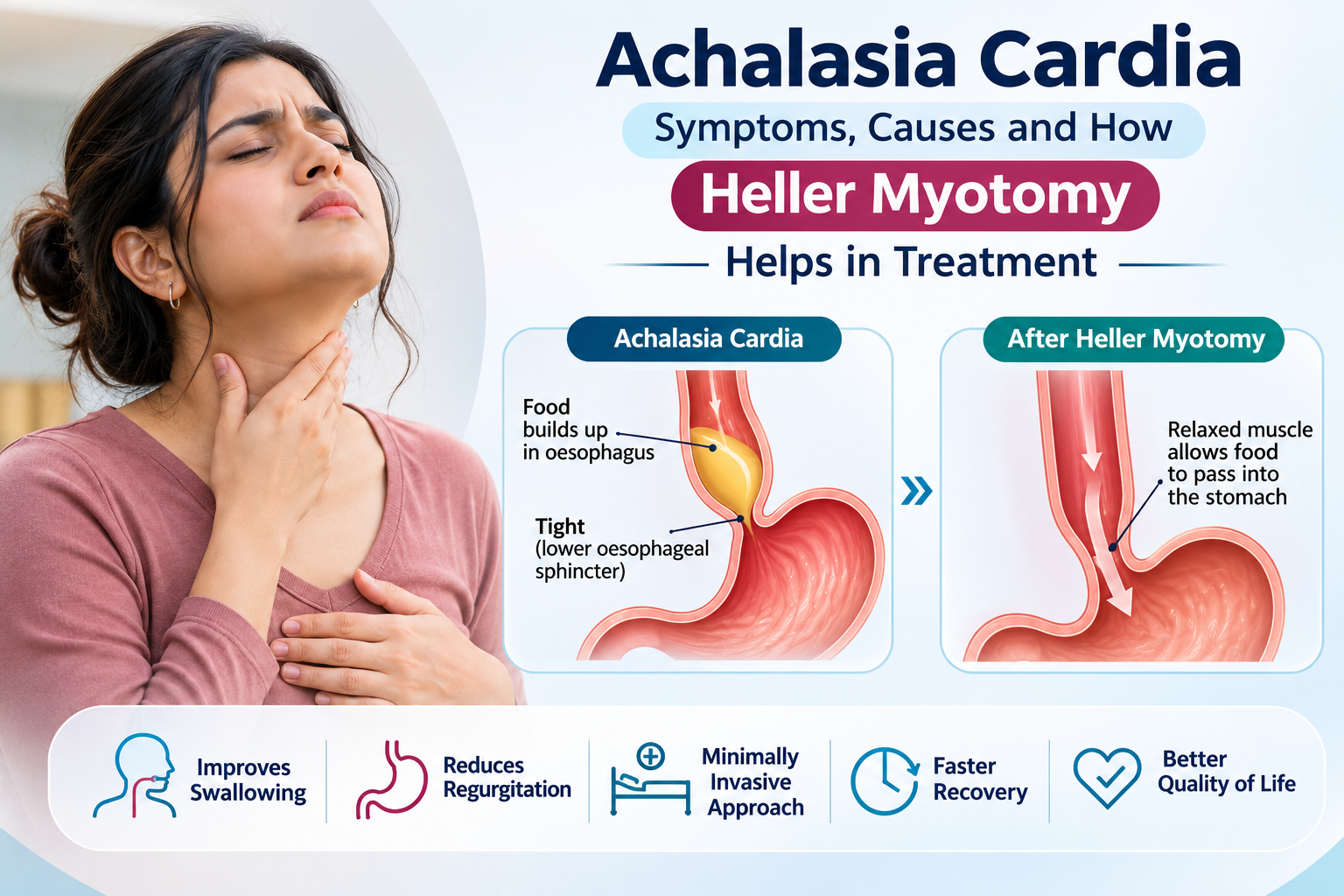
Do you experience difficulty swallowing food, frequent regurgitation, or chest discomfort after eating? These symptoms may sometimes indicate a condition called Achalasia Cardia, a rare oesophageal disorder that affects the movement of food from the mouth to the stomach.
Understanding its symptoms and available treatment options can help patients seek timely medical attention. Heller Myotomy is one of the established surgical treatments for this condition.
What Is Achalasia Cardia?
Achalasia Cardia is a condition in which the muscles of the oesophagus do not function properly. The lower oesophageal sphincter (LES), a muscular valve connecting the oesophagus to the stomach, does not relax normally during swallowing.
As a result, food and liquids have difficulty passing into the stomach and may collect in the oesophagus.
Common Symptoms of Achalasia Cardia
Symptoms may develop gradually and become more noticeable over time. Common signs include:
Difficulty swallowing solid foods and liquids
Regurgitation of undigested food
Chest pain or discomfort
Frequent coughing, especially at night
Unexplained weight loss
Heartburn-like symptoms
If these symptoms persist, consulting a specialist is important for proper diagnosis.
What Causes Achalasia Cardia?
The exact cause of Achalasia Cardia is not fully understood. It is associated with damage or loss of nerve cells responsible for controlling oesophageal muscle movement.
This affects the normal relaxation of the lower oesophageal sphincter and prevents food from passing easily into the stomach.
How Is Achalasia Cardia Diagnosed?
A specialist may recommend different tests to confirm the condition and assess its severity, including:
Upper GI Endoscopy: Examines the oesophagus and stomach.
Oesophageal Manometry: Measures muscle contractions and pressure in the oesophagus.
Barium Swallow Test: Uses X-ray imaging to evaluate how food passes through the oesophagus.
These investigations help determine the most appropriate treatment approach.
What Is Heller Myotomy?
Heller Myotomy is a minimally invasive surgical procedure used to treat Achalasia Cardia. During the operation, the surgeon carefully cuts the muscle fibres of the lower oesophageal sphincter to reduce resistance and allow food to pass more easily into the stomach.
The procedure is commonly performed using laparoscopic techniques. In selected cases, an additional procedure called fundoplication may be performed to help reduce acid reflux after surgery.
Benefits of Heller Myotomy
For suitable patients, Heller Myotomy may provide several benefits:
Improves the passage of food into the stomach
Reduces difficulty in swallowing
Helps decrease food regurgitation
Offers long-term symptom relief for many patients
Can be performed using minimally invasive surgical techniques
The results and recovery experience vary depending on the patient’s condition and overall health.
Other Treatment Options for Achalasia Cardia
Treatment depends on the severity of the condition and the patient’s medical assessment. Other options may include:
POEM (Peroral Endoscopic Myotomy): An endoscopic procedure that releases the tight oesophageal muscles.
Pneumatic Dilation: Uses a specialised balloon to stretch the lower oesophageal sphincter.
Medication: May provide temporary relief in selected patients who are not suitable for other procedures.
A specialist can help determine which option is appropriate.
Consult a Surgical Gastroenterologist in Pune
Achalasia Cardia requires proper evaluation and an individualised treatment plan. A surgical gastroenterologist can assess the condition, explain available treatment options and guide patients towards appropriate care.
At Gastro Liver Care Pune, Dr. Nikhil Jillawar provides surgical gastroenterology consultation for patients with gastrointestinal conditions. Patients experiencing persistent swallowing difficulties should seek medical evaluation rather than ignore the symptoms.
Frequently Asked Questions
1. Is Achalasia Cardia a serious condition?
If left untreated, Achalasia Cardia can lead to worsening swallowing difficulties, nutritional problems and complications due to food collecting in the oesophagus.
2. Is Heller Myotomy a major surgery?
It is a specialised surgical procedure, commonly performed using minimally invasive laparoscopic techniques. Recovery depends on the patient’s health and individual circumstances.
3. Can Achalasia Cardia be cured permanently?
Treatment can provide significant and long-lasting symptom relief, but some patients may continue to experience symptoms or require further treatment.
4. How long does recovery take after Heller Myotomy?
Recovery varies from patient to patient. The treating surgeon provides guidance on hospital stay, diet progression and returning to daily activities.
Conclusion
Achalasia Cardia can significantly affect eating, swallowing and everyday comfort. Early diagnosis and appropriate treatment can help manage symptoms and improve quality of life. Heller Myotomy is an established surgical option for suitable patients, offering relief by improving the passage of food into the stomach.
For evaluation and guidance, consult a Surgical Gastroenterologist in Pune.
Recent Posts
- Benefits of Minimally Invasive Gastrointestinal Surgery: Laparoscopic and Robot-Assisted Approaches
- Complex Hernia Repair: Treatment Options, Surgical Techniques and Recovery
- Achalasia Cardia: Symptoms, Causes and How Heller Myotomy Helps in Treatment
- Robotic vs Laparoscopic Surgery: Which Is Better for Gastrointestinal Conditions?
- Robotic Gastrointestinal Surgery: Advanced Technology Transforming GI Surgery